Tuesday, May 24, 2005

Nokia's Age of Piracy

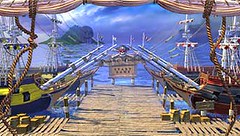
Age of Piracy ScreenshotLooks like everyone's getting on the pirate bandwagon. Nokia has announced a new massively multiplayer cell phone game called Age of Piracy:
Age of Piracy indulges gamers in the fantasy of playing fearless pirates and merciless traders on the unpredictable Caribbean Sea. Head-to-head sea battles, chatting with pirate mates and battle rankings add to the thrill of this treacherous voyage. Gamers have the choice to develop their swashbuckling careers in single or multiplayer modes. Player-to-player trading, special missions to earn fame, chatting and mobile industry first rich comic graphics style round-out the unforgettable gameplay experience of this buccaneer bonanza.

Pirate game in the Virtual Magic Kingdom

DocksAs mentioned over on LearningGames, Disney's multiplayer virtual theme park, Disney's Virtual Magic Kingdom, is now in public beta, and it was made in Macromedia Director (not Flash). That means that with some effort, we can do stuff like that.

Of particular interest is the fun multiplayer pirate sea combat game. This is the sort of look and perspective that I was envisioning for the "Pirate Ship Regatta" game, only it would be a racing game rather than a combat game. Check it out. (Registration required.)

Tuesday, May 17, 2005

Revamp Monkey Fruit Ideas

We've storyboarded one take on Monkey Fruit ... a game designed to help kids understand the process of forming a hypthesis (observe, then create one, then test it) and understand some of the steps in an experiment.

The storyboard is at http://cahedev.nmsu.edu/development/storyboards/hypothesis/. Basically, game players find out that monkeys do different things when they eat fruit... but researchers don't know what they do. So, game players observe monkeys with fruit, then create hypotheses (If I give a monkey a banana, he climbs a rope), then test hypothesis (give the monkey a banana), then report findings on a crib sheet. With the final list of what fruit does what, the game player can run the monkey through a puzzle to get gold.

Here's the problems:

  1. Right now, it is kind of boringly repetitve: watch monkey eat banana, propose what will happen, give monkey banana. Still it is a format of "learn, then play"
  2. We're having trouble figuring out a puzzle where you can use all the fruit at once. It really helps in puzzle games to introduce the gameplayer gradually to a puzzle... first, use a banana, then, use a banana and a mango. This makes the puzzle level really long.
  3. We'd like to merge the puzzle playing (use banana, use mango, etc) with the observation-testing process.


Our new plan is to start with the puzzle, and introduce the player to one fruit at a time, having them hypothesize and experiment each time a new fruit is revealed. In revamping the game, we need to still keep:

  • Observe before making hypothesis
  • Hypothesis includes independent and dependent variable
  • Experiment on one variable at a time
  • Report findings and use the findings to solve problems or develop new experiments


We're going to also take it to paper first, before doing an intereactive proof of concept game.

Sunday, May 15, 2005

Puzzle Pirates review

There's a review of Puzzle Pirates over at GameSpot. It's a game that mixes puzzle games with pirate themes to good effect.

New Approach to Science Content

Originally, our plans were to engage players in three science-activities (Experiment, Observation and Analysis) all related to food safety. We found that this was difficult because there was a certain amount of scientific knowledge required for each of these before they could just jump right in. For example, in the experiment design, we had to - at some point - teach them what independent and dependent variables were.

Our first solution was to introduce a scientist in the brig that the player could converse with. We drafted dialog and scripted out the interaction through which the scientist 'taught' the player how to design an experiment. The problems were 1) it was boring and 2) it was not an effective way to teach... it still wasn't very clear without having the sceintific knowledge put into context.

Our second solution was to use a "school house rock" approach... turning all the boring scientific instructional talk into fabulous musical numbers. This sounded great in concept... but still didn't solve the problems of putting the learned knowledge into context.

Our most recent approach is to simplify out scientific knowledge, and extract out the specific nuggets and skills the game player must have to do an experiment (we're ditching the other two for now), and teach *those* things. Then use School House Rock Songs to fill in the gaps, and have a culminating activity on designing and experiment.

Really the three phases are:

  1. Exposure: Introduce concepts without even naming them. (have games that have an independent and dependent variable, without really calling attention to it or providing lecture on it).
  2. Instruction and Reflection: Introduce more formal terms, with reflection on where and how they were used in context. (So... in the Monkey game, can you tell me which was the independent and which was the dependent variable?)
  3. Application: Once the basics are learned, games actually design and conduct an experiment.


This sounds very boring... but we're really found some fun ways to do 1 and 2. More on that in future posts!

Thursday, May 12, 2005

Proposed Redesign

The problem we were consistently have was wording science instruction. To get to the 'fun' part of designing and experiment, users would have to have conversations with the scientist about what the differences between an independent and dependent variable were... etc. Plus... just having that explained was not enough... we wanted kids to learn and experiment to discover for themselves.

We decided on a new approach, one that would...

Our early plans

After great discussion with experts (both food safety and science education), our plans were to:

  • provide an environment where game players engaged in three types of science processes (experiment, observation, and analysis of existing data) all tied to food safety.
  • The experiment would focus on handwashing
  • The observation would relate to bacterial growth
  • The analysis would look at growth charts and determine the 'danger zone' for bacteria temperature wise
  • Additionally, mini games would help convey concepts like risk assessment, probability, etc.

We decided to address the handwashing first, and created storyboards and a script for the handwashing activity, as well as a interactive storyboard proof of concept. We also developed a more detailed script on the handwashing, and preliminary storyboards on the observation activity.

Wednesday, May 04, 2005

Sample Science Process Game

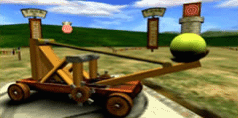
ForgeFX screenshotCheck out these awesome 3D learning gizmos by ForgeFX. In particular, the "Design and Test" activity is a very similar model to the idea of what we want to do with our Pirate game - just substitute building a pirate ship instead of a catapult, and we're there.

Monday, May 02, 2005

Possible Historical Basis for Pirate Science Activity

I was telling some of my buddies about the Pirate game we're designing, and some of the troubles we're having coming up with ways to teach science concepts, and one of them told me about a real-world event that happened during that era that might be of use.

Apparently, there was a town that was having a Cholera epidemic, and people were dropping like flies. Finally, an astute person pulled out a map of the town and started making marks showing where the victims lived and spent their days. When the marks clustered around a town well, they were able to quickly zero in on the cause of the epidemic and thwart it.

This strikes me as a good example of observational science. You obviously can't do strict control experiments, because if you suspect the well is contaminated, you wouldn't ask anyone to drink from it, but you can take quick, decisive action based upon your observations.

Now, it's a little morbid for our target audience, but since we're talking about food safety, perhaps we could have a map showing where people are getting sick. Everyone who was getting sick is eating at the same pirate restaurant, so you can track it down to "Ol' Hook's House of Haddock" or something.